


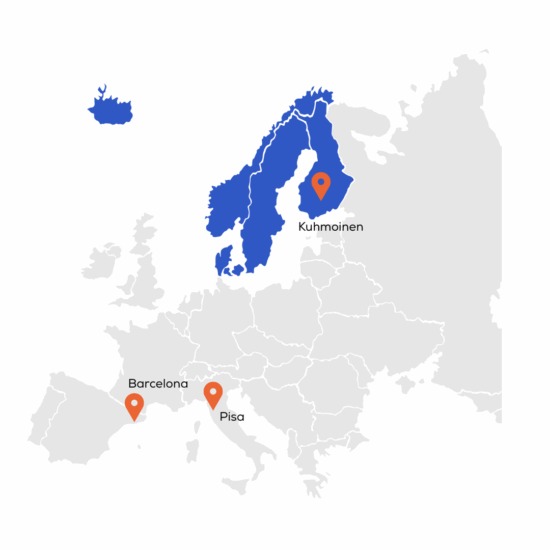
Studying Finnish has been an enormously positive experience for Stefano Chimenti, a native of Pisa, Italy and resident of Barcelona, Spain. Each class brings him closer to the culture and country of his partner, Tita Neittamo. In this interview, Stefano shares his experience and what learning Finnish means to him.
By Hannu Arvio
Hannu: Stefano, you are from Pisa, Italy. You live in Barcelona and you study Finnish. Why?
StefanoWell, actually, it all started with a bet I made with my partner Tita, who is from Finland. Actually, I started with Duolingo, but it was clear from there that Finnish is not a language that is easy to learn by words and so on. So, it was from the bet I made with Tita one night, which I think was before last summer. We were on the couch, and she was talking to me a little in Italian, so I told her I was going to sign up for Finnish classes so I could speak it.
Hannu: Tell us about that moment when you decided to commit to something so important. You hadn’t been drinking or…?
Stefano: Well, I had a little bit to drink, yes (laughs). We were both “cheerful”, with a little wine and so on (more laughter), but jokes aside… I think the wine was what stimulated me to do it at the time. And I signed up that same night. That is, I did it on the spot, but it is true that I already had the idea of wanting to learn. Because of his parents and his friends, who, although they speak English and we can communicate perfectly well, I think it’s something nice. I know Finnish culture because I have been there and because of Tita, but I think the language gives something more.
Hannu: So, you made the decision in a state of euphoria, but there was already a certain depth to it. If you think about the origins of your relationship with Finnish, what was your first contact with the language?
Stefano: In fact, before I met Tita in San Sebastian, I had more friends from Finland, through whom I met Tita, and I always made the joke that Finnish sounded like a ditty to me all the time, and I thought it was funny, but I didn’t understand anything. That was my first contact with Finnish.
Hannu: And now you’ve been studying for two years, is that first impression still there?
Stefano: It still sounds like that to me, but the difference is that now when I listen, I understand words, so it’s different. Actually, when I hear Tita talking to her parents, now, although not always, because they use a lot of puhekieli (spoken language), but yes, if they talk about something I know, yes, I can understand that they are talking about this topic. And with Tita’s mother, since April, I have talked by WhatsApp in Finnish.
Hannu: You are already communicating in Finnish.
Stefano: We always try to do it with something? I mean, you have to think that I don’t do it for work or out of necessity, I don’t really have the need. It’s just something I like. I like to be able to communicate and say something.
Hannu: Your partner is Finnish, and Finland is in your life. Has studying Finnish brought you closer to Finland? In what way?
Stefano: Absolutely, yes. It is key. You said it once in a class, and it’s totally true. The language allows you to understand the Finnish culture even more. For example, I can use humour, but it is understood through the language, not just through the expression. And this is true. Language, like food and other things, is a key part of understanding a culture and understanding people. And in my case, it has surely brought me even closer.
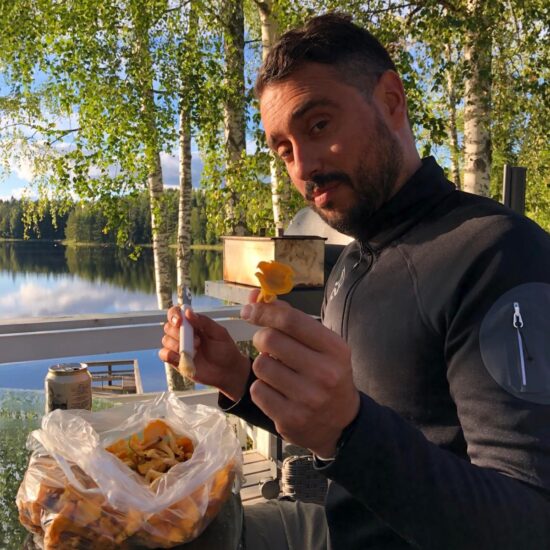
Hannu: And the fact that you are advanced with Finnish, from the first sounds until now, how do you see the language? Finnish has a reputation of being one of the most complicated languages in the world, do you see it that way too?
Stefano: It’s a complicated language. And I realise that it is a complicated language because I believe that both Spanish and Italian are complex languages. So, yes, it is a complex language. There are rules and exceptions; there are many things. It’s an interesting language because it makes sense. Well, it has some things that make sense, some things that don’t make sense. You know, we’ve already talked about it. One thing I really liked, for example, is the snow thing. That Finnish has 40 words to describe snow. It’s very descriptive. That’s a very nice thing about a language. Or, for example, the hobby verb harrastaa. In fact, this is a word that, for me, is very interesting because it represents a concept that is not there in other languages. And this does say a lot about the culture. So, yes, I see it as a very interesting language. Very difficult, but very interesting.
Hannu: It is said that there are many differences within Europe, especially between the north and the south. You are from the south, and Finland is in the north. Do you see those differences?
Stefano: I would say not yet. Because the difference for me, well, maybe the only difference I see, also related to the society and the type of culture, is that, in the South and in Italy, we make a lot of things up. We like to explain everything well, we talk a lot. In the case of Finnish, although this really should be seen in Finnish literature, as a text is written, right? I have the feeling that it’s more like English. I mean, it’s simpler, and it’s straight to the point. It doesn’t get too much more convoluted, right? But I don’t know this either because I would have to read a text in Finnish without translating and understand it clearly. And I think I would be able to see more of a difference thinking about the language as it is, wouldn’t I?
Hannu: Yes, do you see a difference between people? Say, a Finn, an Italian?
Stefano: There is a difference, isn’t there? Yes, there is a difference. But in the aspect, that is, in the expressiveness. In fact, I always make the joke that if you want to stop an argument between Italians, you tie their hands, and it stops because we can’t go on (laughs). In other words, we use a lot of body language. And I have the feeling that in Finland not so much.
The fact of being comfortable in silence. This is a culture shock. This is also seen in the language, I think. If I have to say something, I say it.
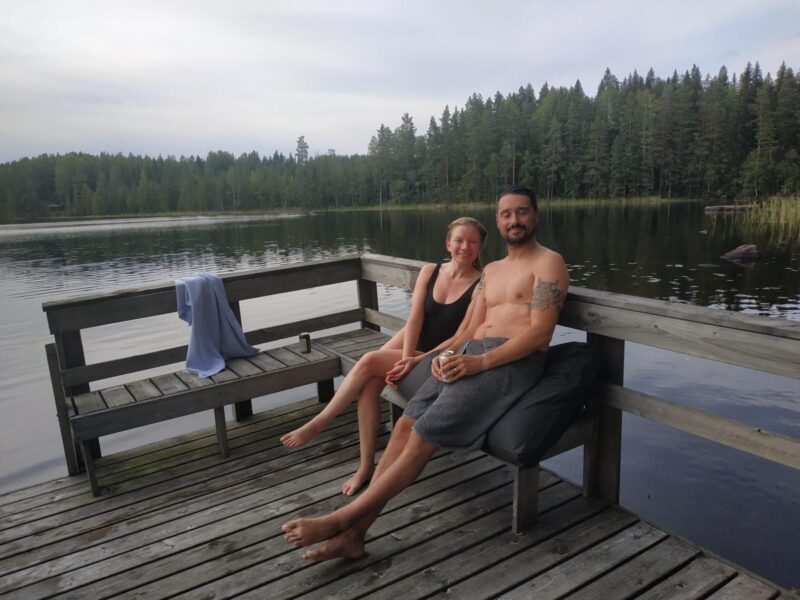
Hannu: You already speak Italian, Spanish and English, and now you are studying a fourth language, Finnish. Has learning, studying, the language of your partner and his family changed you in any way?
Stefano: In general, learning something new always changes you. It has changed me because of the whole learning process, getting into it, studying, and dedicating time to it. Although it’s true that I could have dedicated more time to it, I couldn’t due to a lack of time. But yes, an apprenticeship changes. And learning a language, even more. Because it’s all related to culture.
Hannu: Is the change positive?
Stefano: Yes, of course. Learning is always positive. And learning a language is always positive.
Hannu: What is your goal with Finnish? What do you want to do with the language?
Stefano: Well, as I am not a perfectionist, but very ambitious with many things, at least I feel that if I start something, I want to finish it. So, my idea is to do all the courses. But I don’t pretend to speak it perfectly at a literary level, but for me, the important thing is to be able to communicate. If I want to express something, I want the other person to understand me, and above all, I want to understand what they are telling me. So this is my objective. I will never be the one to remember all the grammar.


