


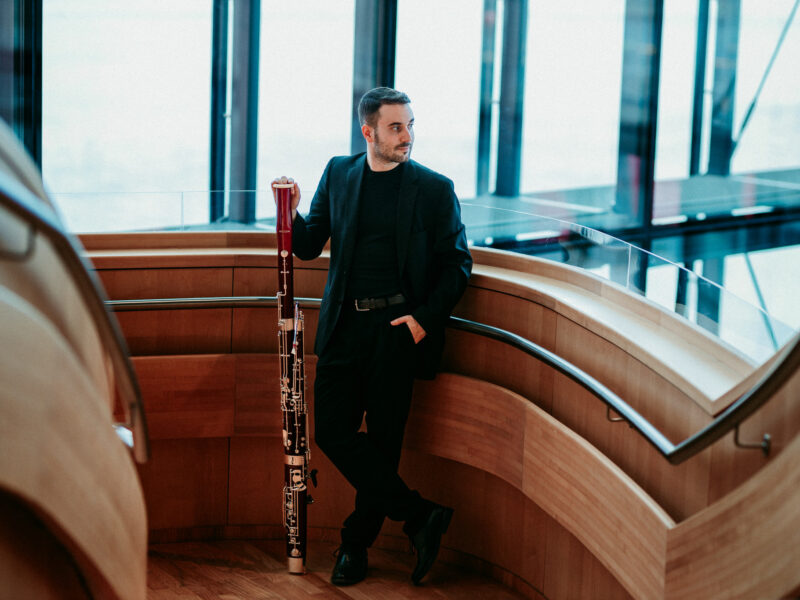
This talented musician from Valencia found his dream job in the Stavanger Symphony Orchestra, Norway, and from the very first moment he has felt at home in the Nordic country. Discover his inspiring story in the following interview.
By Hannu Arvio
Hannu: You are from Valencia. When you started playing the bassoon in Valencia, some years ago, did you ever think that you would end up in the Stavanger Symphony Orchestra in Norway?
Alexandre: No, not at all, not at all. It was all very fortuitous, very random.
Hannu: How did it all happen?
Alexandre: Let’s see, I started playing the instrument from an early age. I started with the violin, then I also played the bassoon, which is what I play now. I studied in Spain until the university degree, then I went to Germany to do a master’s degree, and at the end, I spent about five years. By coincidence of life, the coronavirus also happened, which was a chaos for everyone, and they opened a position in Stavanger. Since it was all very uncertain, I also said, well, it looks good. I didn’t know the city at all, not at all. I had been to Norway once, but very briefly. Nothing, two, three days, which was in Oslo.
Hannu: Did you pass the test?
Alexandre: Yes, so I did a test, an audition. Which was also a little bit curious, because since it was during the coronavirus, the travel restrictions were very strict in Norway. You had to quarantine for 15 days. So my test was by video. That is, I sent some recorded videos of myself. And they selected three of us, out of all the people who had sent videos. And then those three people, one of whom was me, we were already going to play in the orchestra and audition in person.
Hannu: Playing in the orchestra?
Alexandre: Yes, playing in the orchestra and also separately. That is, playing alone with piano, let’s say the usual procedure. But it was like a final round.
Hannu: How long have you been in the orchestra?
Alexandre: I’ve been here for three years. This has been my third season, which I finished now in June. I started in August 2022.
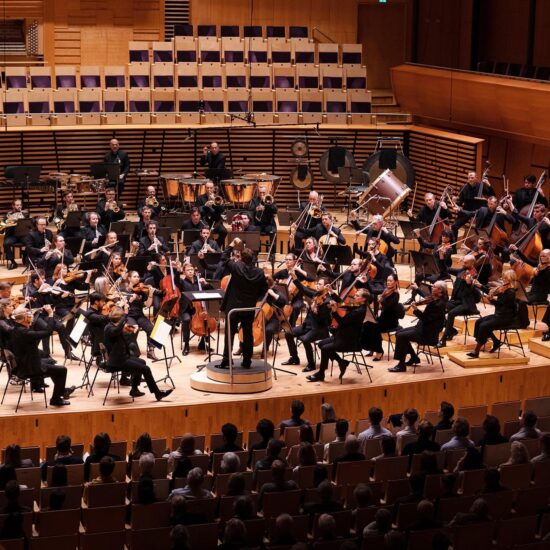
Hannu: I have a question about musical life in Norway. You come from an area (Valencia and Spain) musically very developed. And you are in Norway, in another musically very strong area. Do you feel at home?
Alexandre: It reminds me, in a way, a lot. Because in Norway, there are brass orchestras and concert bands, blåseorkester as they are called in Norway. And yes, it reminds me a lot because they also do contests, competitions, like we do in Valencia or in other places in Spain as well. I feel it as familiar, yes.
Hannu: And what about working in a symphony orchestra in Norway in general?
Alexandre: Well, very well, the truth is that I am very happy and surprised for the better. Because I obviously came from Spain, but also from Germany. Germany, let’s say, is the cradle that is considered to play in an orchestra. It is the country that has more orchestras or where musicians move more. In Berlin above all, but also in Munich, in Cologne, in Frankfurt. The standards in Norway are almost as high as in Germany in every way. Not only on an artistic level, but also on a labor level, on working conditions. And the truth is that, as I was saying, it was a bit of an adventure for me, I didn’t really know where I was going to end up when I went to Stavanger. And I was very pleasantly surprised. It makes it very difficult for me if I wanted to return to Spain. The working conditions I get (in Norway) are very good. And the working environment is ideal, really. We have, specifically, in Stavanger, a practically new auditorium, which was inaugurated in 2012 and is one of the best in Europe.
Not only is the atmosphere among colleagues rewarding, but the working conditions are unbeatable.
Hannu: Let’s talk a little bit about the climate. You leave the Levante, the Mediterranean, which is one coast, and you go to another coast, which is the North Atlantic. Could you say that you have moved from sun to rain?
Alexandre: Yes, yes, literally. Well, yes, but in my particular case, as I had also been in Germany for five years before, well, I almost welcomed it, because I didn’t have a coast in Germany, because I was studying in Mannheim, near Frankfurt. Coming back to the coast, although it is very different, I liked it very much. It was also a bit like coming home in that sense. But it is true that the rain is much more abundant, the lack of sun also in winter, especially. But I like it because it is a different kind of sea. It feels a little purer. There is much more wind, the Mediterranean is calmer, more stagnant. And it is much more humid in Valencia than in Stavanger. Obviously, I had to buy all the waterproof clothes I had been warned about. But very well, the truth is that I am very comfortable.
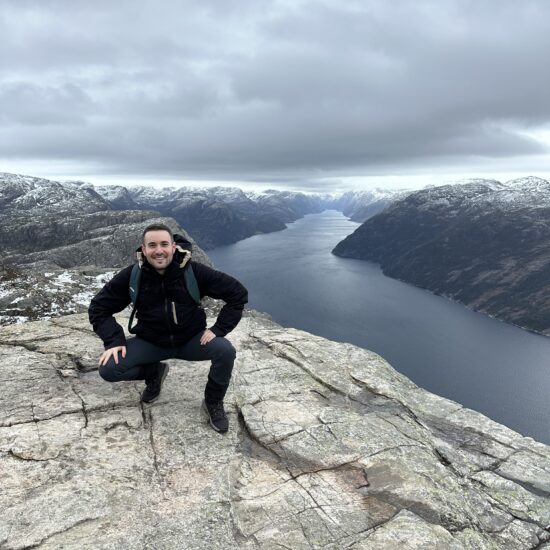
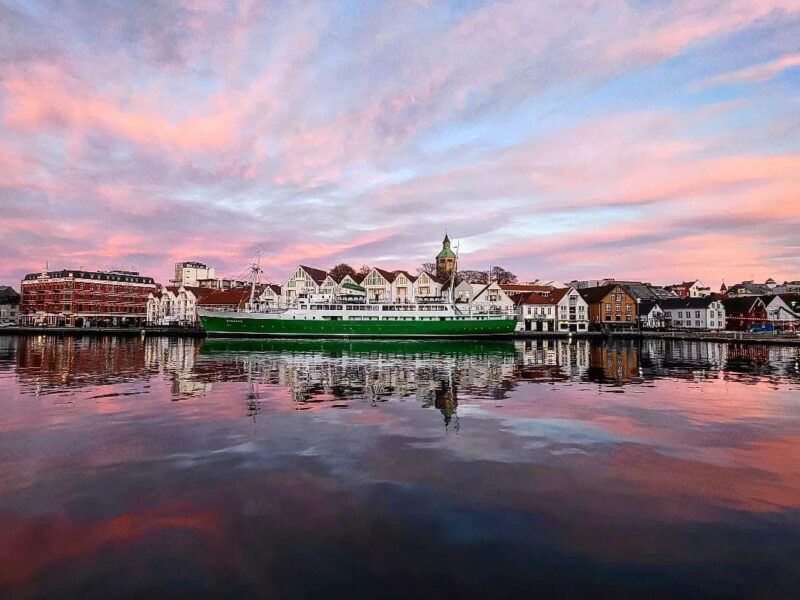
Hannu: Stavanger is the third largest Norwegian city (230,000 inhabitants). How have you adapted to life in general? In the home environment, housing, food?
Alexandre: Well, the truth is that it is quite good and relatively fast, so I was telling you that the conditions I get in the orchestra are ideal. To begin with, the midday meal is at work, which is the lunsjIt is in the middle of the rehearsal, in the middle of the working day. We have the orchestra’s canteen there and also very cheap prices. And as for finding a place (home), it was relatively easy, because they helped me, not only my colleagues in the orchestra, but also from the administration. Any kind of problem or doubt you may have regarding documentation, they were always very nice and helped me a lot. And the good thing about Stavanger is that since it is smaller than, for example, Valencia, I could find something relatively close to my place of work. On a social level, the orchestra is very international. There are Norwegians, obviously, but there are also Swedes, Germans, and French; there are Americans, Asians too, from Japan or China.
It’s funny because in Stavanger, for being so small, the atmosphere is very international, so it’s very nice or very easy to fit in coming from outside. And in my case, there are also a lot of Spaniards, obviously. In the orchestra there is another guy, who, in fact, also came to the Institut Nòrdic before me, that’s why I come here, because he recommended him to me. He told me: “Look, this is perfect for us because it is from Spanish, Spanish-Norwegian, Norwegian-Spanish, and you do it online“. And the truth is that it has been very good for me, and that’s why I keep doing it. And also, the orchestra where we work covers the expenses of the Norwegian course, etc. So it’s very easy. The truth is that everything is ideal.
Hannu: We talked a bit about the language itself, Norwegian. How did it sound to you when you first heard it?
Alexandre: Well, slightly familiar, because as I said before, I was in Germany, I had already been there for five years, and obviously I had already had to learn German. And it has certain similarities, even before I started the Norwegian course, some words I already understood by context, because the vocabulary is Germanic, it comes from very similar origin, or also from English, a little bit. So it’s like at the beginning, without knowing anything, I already understood something by sympathy between English and German; I saw something in between. What does happen to me, and obviously I still suffer a little bit, is with the dialects. They have many dialects, and depending on the person, sometimes I think I’m not learning anything, or I understand practically 90% of what they say.
So yes, at the beginning it was curious, because I understood something, but I didn’t speak it and now that I’m a little more fluent and I’ve been there for three years and so on, I start to see more details, I start to realize more things about the Stavanger dialect where I am, because of course I’m learning Bokmål, which is like the standard dialect, which is the one that is taught to foreigners and the most predominant in the Oslo area. And when I go to Oslo, suddenly I feel more comfortable because I understand pretty much everybody, but in Stavanger, sometimes it’s funny that depending on the dialects, sometimes I suffer a little bit.
Hannu: And do you have any goals with the language?
Alexandre: My goal is to have a minimum of fluency to be able to live without any problems on a daily basis and to be able to defend myself without any problems, even if it is at a work level. Although obviously in Scandinavia they make it very easy for you too, because practically everyone speaks English. But I do notice it, that they appreciate it, that you speak and use their language. And the truth is that I feel more comfortable when I can have a conversation in Norwegian with someone who is a native speaker because I see that the connection is a little bit more personal.
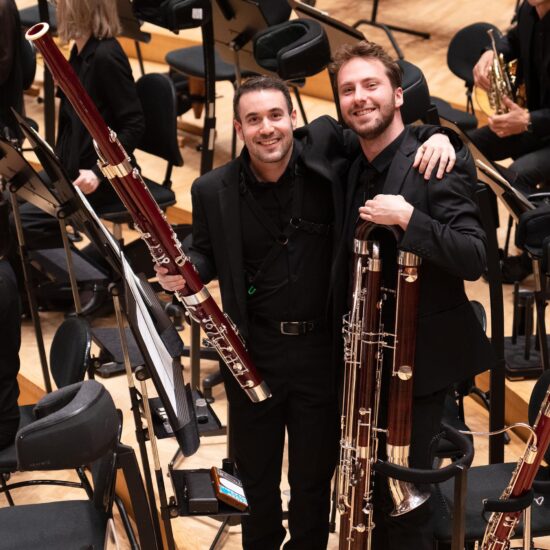
Hannu: What languages do you speak?
Alexandre: I speak Spanish, Catalan, Valencian because I grew up there, but also obviously English, German. In fact, I could say that I’m even fluent in German, maybe even B2. And now, well, Norwegian too. .
Hannu: So you are studying your fifth language.
Alexandre: Yes, in a manner of speaking. I’ve also studied some Italian, but we leave that a bit more to the amateur level.
Hannu: A question for a musician: In what language do you count the waiting measures?
Alexandre: Not just the waiting beats anymore, but also when I go to the gym, you start counting. And I realize that it depends on the day. Sometimes I count them in English, sometimes I count them in Norwegian, sometimes I count them in Spanish. That’s funny. But the truth is that lately, more and more is in Norwegian.
Hannu: What are your plans for the future? You seem to be very happy in Stavanger, do you think you could stay there for a long time?
Alexandre: Well, I talk about it many times with my family and friends, and the truth is yes. I mean, I have honestly gotten used to or I have felt quite welcome and comfortable in the Scandinavian environment. And I see that the chances of me staying, if not in Stavanger, but maybe in Norway or even in Sweden, as I also work there from time to time, are very high. In other words, I see myself spending the rest of my life in the northern countries.
Hannu: Why?
Alexandre: For me, the most important thing is the work environment, which is very favorable and healthy. The working conditions, you feel very welcome, and there is a lot of support for everything that has to do with your trade, with your work, at the level of material that we need to buy, or also at the artistic level, in our case, of profiles. And the truth is that I like it, not only at a personal and artistic level, but also at a work level; for me, it is ideal. In my field, at least, it is one of the best there is.


