


Although Estera (Warsaw, Poland) and Narot (Aranda de Duero, Spain) live in their respective countries, their love knows no borders. To shorten the distance and share a goal, they chose an original way: to sign up for an online Norwegian course at Institut Nòrdic. Their experience is proving to be a success, and in this interview, they reveal the details.
By Hannu Arvio
Hannu: Before you became a couple, did studying Norwegian ever cross your mind?
Estera: No, not really, because I always had the idea that Nordic countries are cold countries like Poland, and since I have my own cold in my own country, I didn’t think it was worth going there. I was always a little bit more attracted to countries like Spain, Italy, and Portugal. I loved learning languages, but it was never my first idea to start learning Norwegian, really.
Hannu: So, what I can deduce is that it is a Spaniard who has led you to study Norwegian.
Estera: Partially yes. I like warm weather, and Narot loves cold countries, and three years ago we went with our friends to Norway. At that time, we had no plans to do the course together or to start learning Norwegian together. And we went to Norway, everything was very nice, beautiful, I loved what we saw, the people, the culture, the breathtaking views. Right, Narot? And I think after that trip was the moment when we started to think that it would be great to add to our long-distance relationship something that we could do together as a couple.
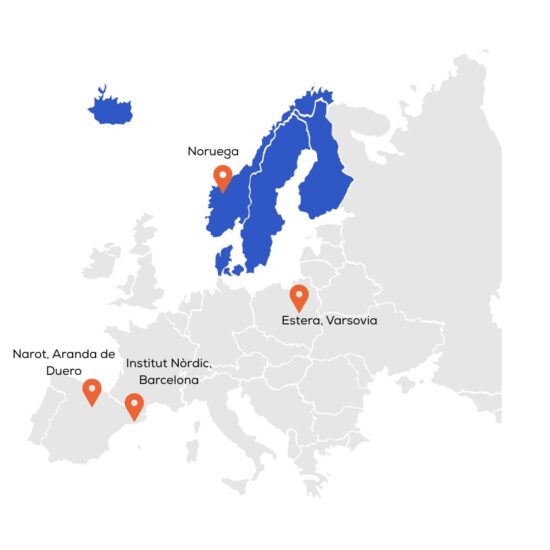
Hannu: Interesting. Being a long-distance couple.
Estera: It was like an advanced level added to that relationship, of course, because we had to find something that we could both do online, obviously, and on a regular basis. So we did go out with the idea of learning a language.
Hannu: So this Norwegian course you are doing together is like a part of the couple project.
Narot: Yes, a little yes.
Hannu: Narot, what was your first contact with Norwegian?
Narot: Well, many, many years ago. Because when I was in high school, like 18, 19 years ago, I always liked Scandinavia and I really liked the Scandinavian languages, the culture, and everything. So I had some friends who also liked it, and I don’t know, it was always funny. And when the internet started and social networks started to appear and so on, we always looked for people from Scandinavia and tried to talk. And I remember, I have it somewhere, I had an old Norwegian dictionary that I bought in Madrid. I was all happy trying to learn how to write four little things and so on. And then I have traveled several times to Norway, to Sweden, to Finland, to Denmark and to Iceland. I’ve been to all the countries and to some of them more than once. And nothing, I always wanted to study Norwegian, but well, for life’s sake I studied Finnish too.
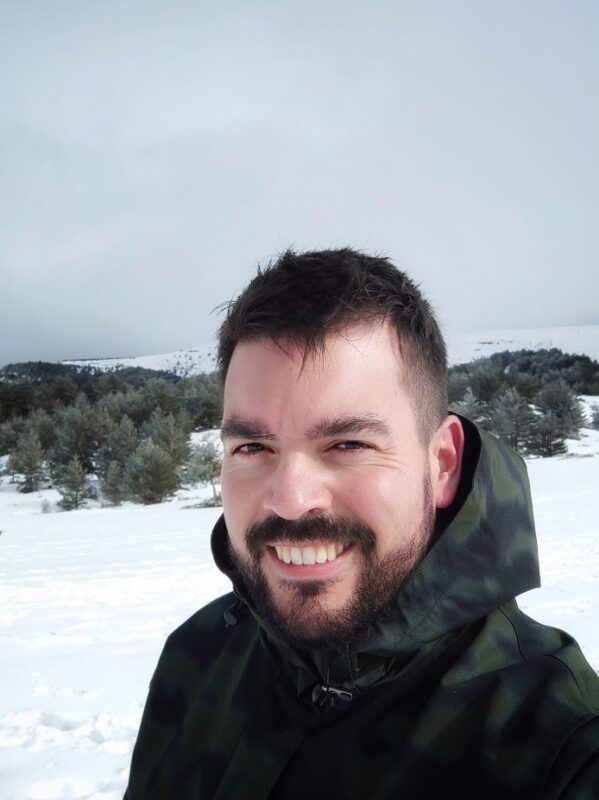
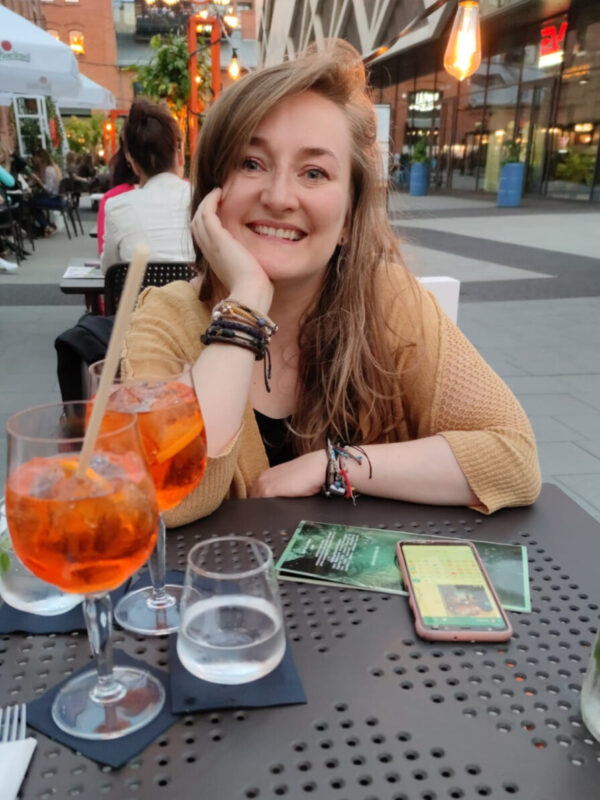
Curiously, Estera, despite being from the north (Poland), abhors the cold. The opposite is true for Narot, who, being from the south (Spain), prefers it: the colder, the better.
Hannu: Estera, you have studied many languages.
Estera: Yes, English, Spanish, Italian, Portuguese, Japanese, German, and Norwegian.
Hannu: And Polish is your mother tongue. About Norwegian, how do you see it after all these? Is it difficult? Easy?
Mat: For me? Let’s see, medium-medium. Some of the grammar is much easier than, for example, Polish grammar or Italian and Portuguese grammar, but in terms of vocabulary or phrasal verbs, it’s very similar to English (sometimes). And these are things that always cost a little bit. So I would say that it’s not the most difficult language in the world to learn, but you have to spend time speaking, studying vocabulary, and just to understand better.
Hannu: Narot, you start from Spanish, how do you see it, Norwegian?
Narot: Funny. I’ve also studied a little bit of German, and sometimes I see it a little bit like a mixture of English and German. So, knowing English and having studied some German, Norwegian didn’t seem very complicated to me at the beginning. It is true that the vocabulary, like all languages, you have to learn. Perhaps what I find most difficult are the prepositions, which I always confuse. But, as far as I can tell, Norwegian is, I would say, easy. Because the grammar is not very complicated, actually.
Hannu: Narot, have you been to Poland a lot?
Narot: Me, yes. I’ve been, I don’t know, how many times have I been, 10, 12, 15 times? Well, four times a year.
Hannu: And you, Estera, have you been to Spain a lot?
Estera: Yes, even before I met Narot, I did the Erasmus program in Spain and worked a bit in the Canary Islands and Galicia.
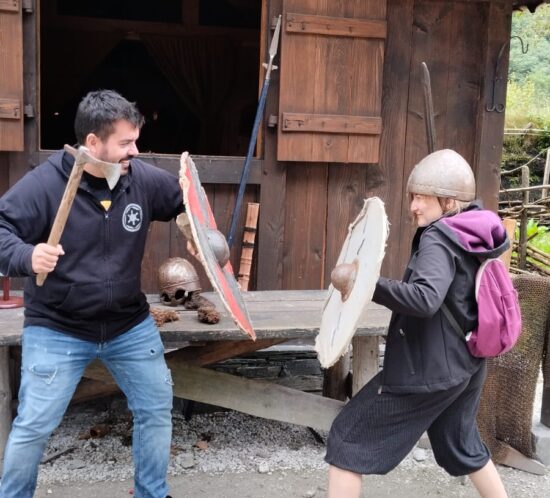
Hannu: Norway as a country, what do you think? Narot, you have said that you have always been a fan of the Nordic countries, have you changed your idea of the Nordic countries over time?
Narot: Me? No way, I am still delighted. In fact, now I’m looking forward to going back. Estera and I have talked about the fact that we have to go back to Norway because now we also speak Norwegian.
Hannu: And Estera, you who saw the Nordic countries as a continuation of the cold, for you has anything changed, any new perspective?
Estera: Yes, very much so. Norway also has a lot of fame among Poles who go there to look for work. So, I more or less had that idea of a Nordic country, a country with a lot of cold, expensive, and with Poles looking for work there, but it was all the other way around. And the truth is that I fell in love with that part of the world that I never thought I could fall in love with, with all my love for the heat, the paella, the flamenco, and the happiness of Spain. I fell in love with Norway, its fjords, and its cold.
Hannu: Speaking of Norway, we can’t forget about working life. Estera, what do you do?
Estera: I am a course coordinator in a company dedicated to video game testing. In education, I am a psychologist and pedagogue.
Hannu: And Narot, you are a graphic designer. Norway is a country with a reputation for a very good working life and high salaries. Has it ever crossed your mind to look for something there?
Narot: Many times. Even living together. Many times, yes. I, in fact, a couple of years ago I was out of work. Then I was studying for a master’s degree and, quote unquote, I’ve been looking for a job there. Because it’s true that I’ve been looking mostly with Norwegian companies remotely, if possible. But we have said that our idea is to move to Spain and live together in Spain for a while. But we haven’t ruled out if, after a few years here in Spain, we try to look for something there.
Estera: For me it would be very nice to live the six summer months in Norway and the six winter months in Spain. That would be a great plan.
Hannu: True, it is the dream of many.
Estera: For me it is also important to speak Norwegian well. I think going there and looking for a job I would like to go there when we already have a B2 or C1 level of Norwegian to speak well.
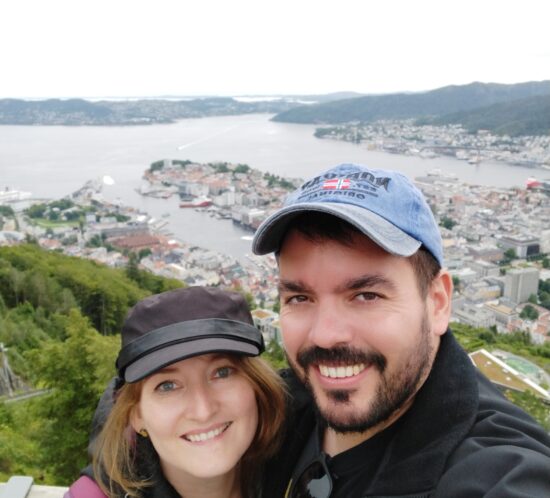
Hannu: As you are a couple, let’s talk about couples. Do you know any other couple that does the same as you?
Estera and Narot: No. No, no.
Hannu: What does such a project give you as a partner? Because, in fact, you see it as a project with some depth. It’s not just meeting every week for class, but, as we just mentioned, at some point, maybe you’re going to live together in Norway. So, could you tell a little bit more about how this couple project has developed?
Estera: Yes, well, the first thing that comes to my mind is a joke that we always make on Mondays at eight o’clock in the afternoon, that we come into class and we say, oh, Narot, long time no see (laughs). Let’s see, Narot, maybe you can help me explain it a little bit, but I think a very important part of this project is that we spend time together doing things like studying together, having things to talk about, and we do our homework every week, always together. We also have a new group of friends, who we share those friends with at the end, who are our classmates. The truth is, our group is very special at school, I think, because we talk, we laugh, we chat, we help each other. Last year, the kids went to Barcelona to visit Martine. So I think that this project is not only to have another language to learn and to speak. Which I always think is good for the brain, to just say yes, I know how to speak Norwegian, but also to create a lot of common ground, as a long-distance couple. We can share more than just day-to-day conversations. Studying Norwegian together brings us closer as a couple.
Narot: Yes, it brings us closer in the end, that’s what Esti says, isn’t it? If we see each other every Monday, we meet to do homework, we share things in Norwegian, or I give Esti a book in Norwegian, well, in the end it has become a little bit part of both of our lives and it helps to strengthen ties between two people who live 4000 kilometers away from each other.


