


Once again, students from Institut Nordic embarked on a cultural trip to a Nordic country.
This year, our destination was Oslo, the beautiful and eclectic capital of Norway. It had been since 2018 that we last visited, and that trip took place in winter.
This time, we experienced a very different weather pattern, enjoying the city in all its spring splendour with long, sunny days and wonderful temperatures.
And, fortunately, there was no rain! However, it’s always wise to pack a raincoat when travelling to any Nordic country.
This year’s trip took place between 1 and 4 May and included a group of 17 students from Institut Nordic, accompanied by Martine Hansen, director and head of Norwegian, and Laia San José Beltrán (The Valkyrie’s Vigil), a B1 Swedish student and expert in Nordic culture and history.
For this trip, Institut Nòrdic has designed a programme that combines the modern side of Oslo, with its surprising and diverse architecture, with the oldest and most culturally rich side of the city, which is brimming with history.
The programme includes visits to iconic and tourist attractions, as well as other lesser-known or less common places.
Of course, the gastronomic experience could not be missed: trying the typical food of each place is an excellent way to learn a little more about the country.
We had dinner at the Schrøder restaurant, which serves traditional Norwegian food such as reindeer and klippfisk-style cod. It is a well-known restaurant in the city for its age and for having appeared in several works of fiction, including Jo Nesbø’s crime novels about Harry Hole and some of Bjørg Vik’s books.
What’s more, as it was a public holiday on 1 May, we were lucky enough to see the streets filled with people wearing traditional costumes, such as the magnificent women’s bunad. It was a truly immersive cultural experience.
Below is a detailed itinerary of the trip:
Thursday, May 1 (free time)
Arrival of students from their various places of residence.
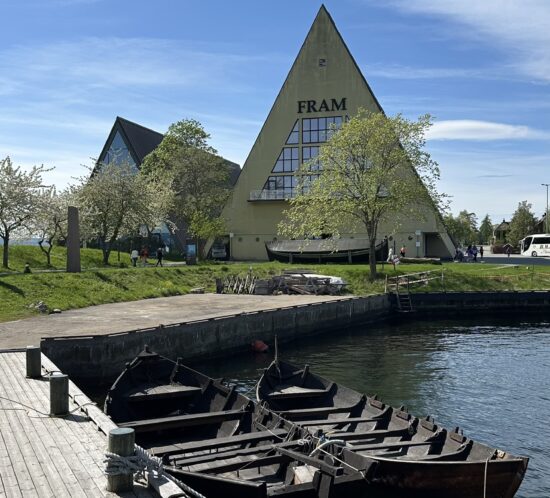
Depending on their arrival time, some took advantage of the day to take a ferry tour of the Oslo Fjord, others visited Akershus Festning (the city’s fortress, which houses the Norges Hjemmefrontmuseum (Norwegian Resistance Museum), and others visited museums such as the Fram, the Kon–Tiki or the Nasjonalmuseet, the national gallery.
Friday, May 2nd
After a hearty breakfast at the hotel, we headed to Frognerparken, one of Oslo’s most famous and largest parks, where we visited Vigelandsanlegget – known to tourists as Vigelandsparken – a collection of sculptures created by Norwegian sculptor Gustav Vigeland (1869–1943).
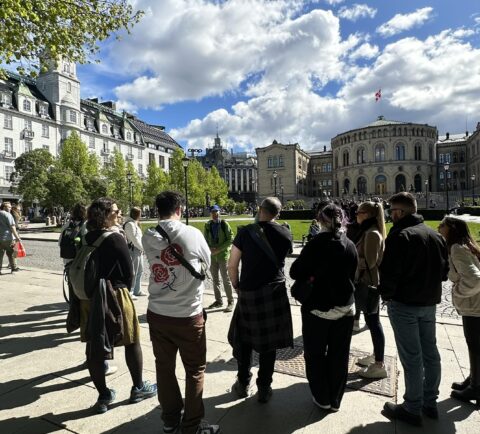
We took a tour with a city guide, Hernán, who then took us on a walk along the city’s most famous street, Karl Johans Gate, and its surroundings, where we visited Slottet (the Royal Palace) and Slottsparken (its gardens), Stortinget (the parliament), Nationaltheatret (the national theatre) and the Norske Nobelinstitutt (the Norwegian Nobel Institute).
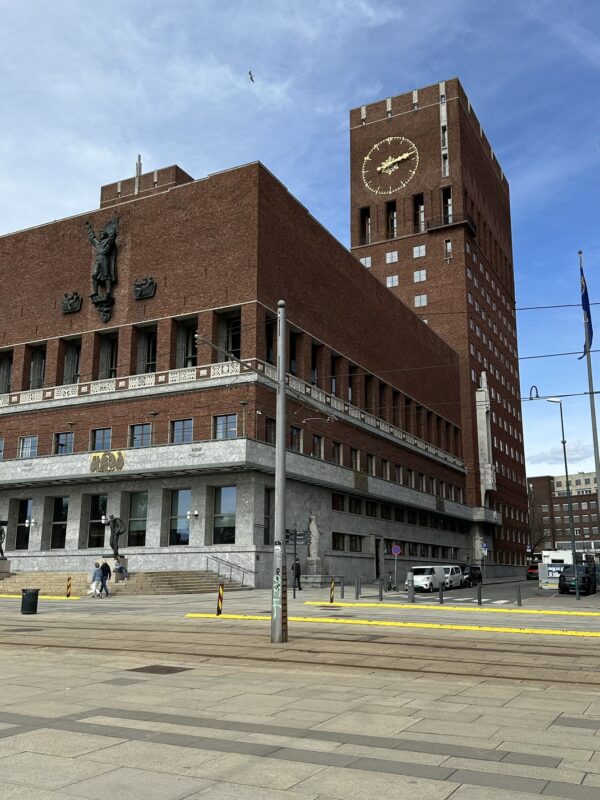
We ended the morning at Oslo Rådhus, the city hall, admiring not only its spectacular brutalist architecture from the outside but also its interior, which is full of works of art and huge murals. It’s a much less touristy plan, but well worth it.
After a few hours of free time, which some people took advantage of to eat, stroll around and visit the Munch Museet, we met up at the museum’s café for a little fika (coffee and a typical Nordic pastry, a very popular activity in Sweden) to recharge our batteries and finish the afternoon strolling through the Bjørvika neighbourhood, in the small bay of the fjord.
This is another of Oslo’s urban and architectural flagships, where visitors can explore buildings such as the Opera House, the Munch/Stenersen Museum, the Deichman bibliotek (the new Oslo public library building), the Barcode complex, and the public sauna area.
To end the day, free time for dinner. Near the hotel in Sotorgata is Oslo Street Food, located in the Torggata Bad building – the city’s former public baths, built in 1925 – which is now a market featuring stalls selling a wide range of traditional and non-traditional food.
With tables and benches everywhere, it is a modern, multicultural place full of very pleasant places to eat, which some of our students were able to enjoy.
Saturday, May 3rd
We began the morning in the hotel lounge with a talk by Laia San José Beltrán about the Vikings, exploring their reality and their impact on popular culture.
This served as a prelude to our visit to the Kulturhistorisk museum (the cultural history museum), where an archaeologist from the museum guided us and explained some of the most important and outstanding pieces in the Viking exhibition, such as the Gjermundbu helmet, the only helmet from the Viking era that has been preserved (without horns, of course!).
Afterwards, we had free time to finish seeing the museum, stroll around and have lunch before heading straight to the ferry at Aker Brygge to the island of Bygdøy, where we visited the Norsk Folkemuseum (Norwegian Museum of Cultural History), which was founded in the late 19th century and is considered the world’s first open-air museum.
It houses extensive collections of objects and artefacts from all social groups and regions of the country. However, the most striking feature is its collection of over 150 Norwegian buildings, most of which have been relocated from villages and rural districts.
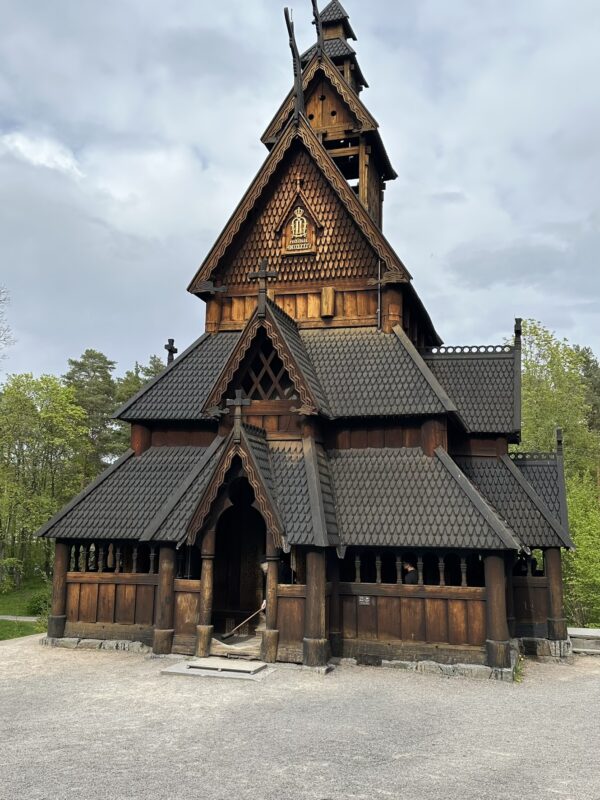
Among the museum’s most significant buildings are the 13th-century Gol stave church (a typical Norwegian wooden church), the 14th-century Rauland farmhouse (Raulandstua) and the 1865 residential building moved from 15 Wessels Street in Oslo. Many of these buildings can be visited inside and feature re-enactors who show and explain what life was like in the past.
We concluded the day and the group trip with a group dinner at the aforementioned Schrøder restaurant, where we sampled typical dishes. A magnificent finale.
Sunday, May 4 (free time)
Before catching their return flights, some took the opportunity to stroll around some of Oslo’s most iconic areas, such as the Aker Brygge waterfront and the Tjuvholmen neighbourhood, an area located on a peninsula jutting out from Aker Brygge into the Oslo Fjord.
At the tip of the peninsula is an outdoor swimming area, which on Sunday morning was full of people of all ages enjoying sports. This was once a loading and unloading port and shipyard, but today it is one of the newest and most modern areas of Oslo, with striking architecture.
Since 2005, a major transformation has been underway as part of the Fjord City urban renewal programme. Today, there are homes, office complexes, art galleries, the Astrup Fearnley Museum of Modern Art and the Haaken Gallery, as well as the Tjuvholmen sculpture park. There are also many shops and restaurants.
To experience the contrasts that Oslo has to offer, a few hundred metres away, we visited the Kvadraturen neighbourhood, one of the historic districts, and Christiania Torv square, where the building that housed the city’s first town hall, Gamle rådhus, from the mid-17th century, still stands.

What are the Institut Nordic trips?
Every year, we offer a trip for students and accompanying adults to a Nordic destination.
To date, we have visited Stockholm, Copenhagen, Malmö, Gothenburg, Uppsala, Bergen, Oslo, Tampere and Helsinki.
Students can participate in any trip, regardless of the language they are studying and their level.
At Institut Nòrdic, we typically plan trips lasting four days and three nights – although some people choose to extend their stay – to visit the most outstanding places in the destination, accompanied by local guides or experts, seeking a rich cultural immersion experience that complements what we learn in class.
On our trips, we combine group visits and activities with free time, allowing everyone to have a more personalised experience.
In short, Institut Nòrdic trips are a great way to test your language skills and discover the culture of the country. Where should our next destination be?


